Self-paced online education
Facial Anatomy for Aesthetic Practice
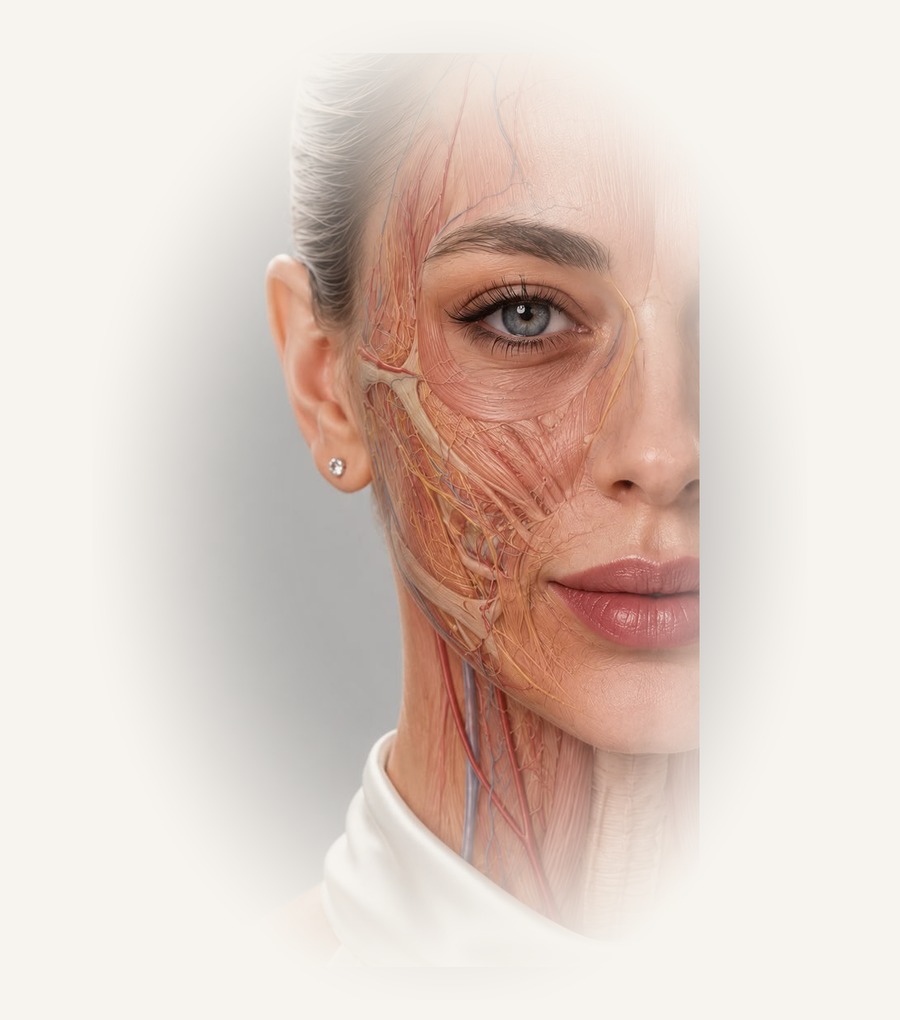
Understand facial structures and their relationships, then connect regional anatomy with assessment, movement and risk recognition.
Price and access
£295
Specialist Masterclass · complete online course
7 modules · 10 learning hours · 12 months of access · price includes VAT
Who this course is for
Registered healthcare professionals exploring aesthetic practice or revisiting the science behind their existing work. Study at your own pace, with visual lessons, recorded explanations and knowledge checks.
Check entry requirementsWhat you will understand
Study the facial structures and regional relationships that inform assessment and help you understand anatomical risk.
What you will study
1.Core Facial Anatomy and Ageing4 lessons
Explore facial layers, retaining structures, muscles, nerves and ageing as a foundation for regional anatomy.
1.Why anatomy matters in aesthetic practice
Why a gap in anatomical knowledge matters more here than in almost any other part of aesthetic practice.
2.Planes, layers, retaining structures and ageing
The face as a stack of layers — skin, fat, fascia, muscle and bone — and the way each of them changes as a patient gets older.
3.Muscles, nerves and functional assessment
The muscles behind expression, the nerves involved in sensation and movement, and why everyday function belongs in assessment.
4.Region-based anatomy for treatment planning
What changes if you think of the face as five overlapping systems, rather than as one continuous surface.
2.Vascular Anatomy and Injection Safety3 lessons
Study vascular territories, anatomical variation and danger areas, linking anatomy to risk recognition.
1.Vascular territories and danger areas
Six regions, connected anatomy, and recognising risk before deciding to treat.
2.Anatomy-informed risk reduction
How anatomy can be used to reduce risk before a treatment begins.
3.Recognising and responding to vascular compromise
The signs of vascular compromise and how you should respond.
3.Upper Face: Forehead, Temples and Glabella3 lessons
Study the layers, muscles and relationships of the forehead, temples and glabella using regional illustrations.
1.Forehead
Why the forehead needs its own careful map of layers and vessels before anything else.
2.Temples
Why a region used for chewing, not expression, is still essential to understand for aesthetic practice.
3.Glabella
Why such a small, smooth patch of skin sits among the most carefully treated areas of the face.
4.Eyes and Periorbital Region2 lessons
Explore upper-eyelid, brow, under-eye and tear-trough anatomy and their structural relationships.
1.Upper eyelid and brow
Why brow position changes how the upper eyelid looks, and how to tell the two apart in consultation.
2.Under-eye and tear trough
Puffiness under the eye can look the same from one patient to the next, so why the cause matters so much.
5.Nose and Midface3 lessons
Understand the anatomy of the nose and the medial and lateral midface.
1.Nose
How the nose is built, how its small muscles work, and why its blood supply matters so much for safety.
2.Medial midface
How the muscles, fat compartments and connective tissue of the inner cheek fit together, and how they change with age.
3.Lateral midface
What lies in the outer cheek, how its tissues move, and how it relates to the temple and jawline.
6.Lower Face and Neck3 lessons
Study the lips, chin, jawline and neck, connecting structure with movement and regional assessment.
1.Lips
Why lips age the way they do, and what that means for assessment.
2.Chin
Why the chin is central to the facial oval, and how bone, muscle and nerve all shape it.
3.Jawline and neck
How the jawline and neck connect the face to the body, and why that makes them a distinctive assessment area.
7.Course Review and Final Assessment1 lessons
Bring regional anatomy together and test your understanding in the final course assessment.
1.Final anatomy assessment
Your end-of-course theory assessment, covering the whole subject. Passing it, alongside your course evaluation, is what allows a course certificate to be issued.
Learning hours and your certificate
10 hours of structured learning for the complete course. Complete the learning, pass the final theory assessment and submit your course evaluation to receive your ECHO course certificate.
ECHO is CPDUK Member Organisation 50537. These are ECHO's confirmed learning hours, not a claim of individual course accreditation. The certificate recognises theoretical learning, not practical competence or permission to treat.
Read about assessment and certificationRelated learning
Consultation, skin science and complications education can help you connect this subject with assessment and patient safety. Choose only the areas that fit your learning goals; there is no compulsory additional purchase.
Online theory includes 12 months of access. Practical training and mentorship are separate.